How to Choose a Bath Mat for an Awkward Bathroom Shape
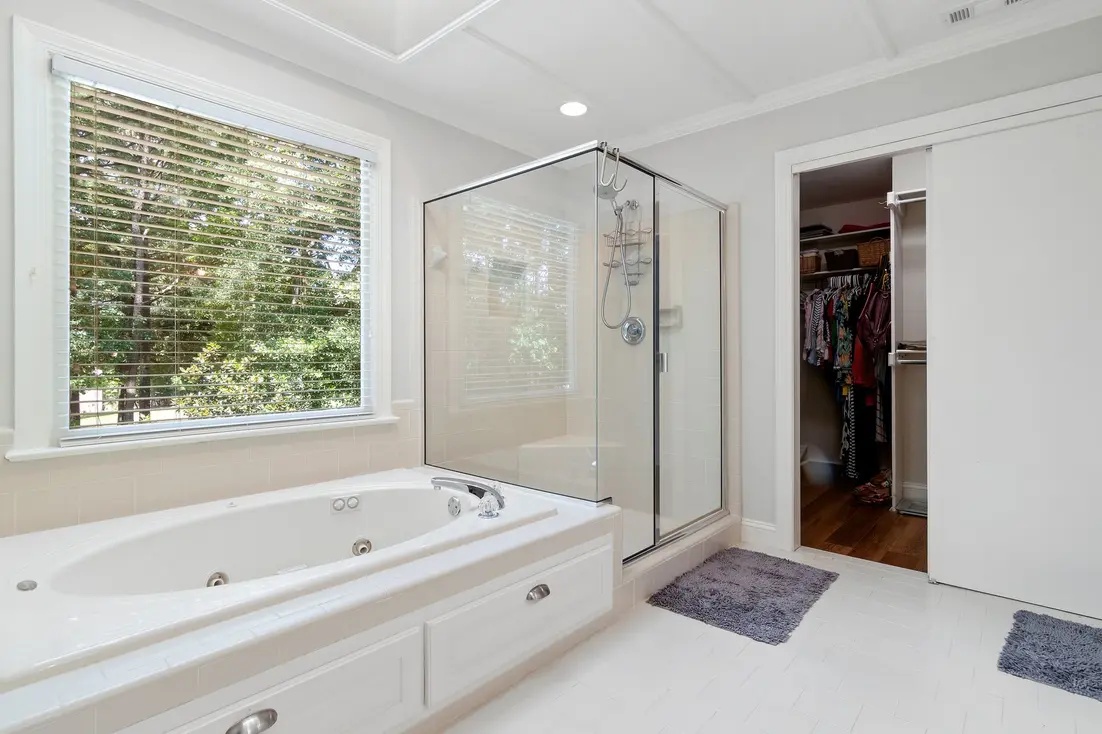
A bath mat for an awkward bathroom should be chosen from the usable floor area, not from the room’s widest measurement. Measure the clear space beside the bath, shower, or vanity, make a paper template, and check door movement and walking paths before buying. In many bathrooms, a narrow runner, small separate mats, or a washable bathroom-suitable rug works better than trying to force a standard rectangle into an irregular corner.
The goal is not to cover every inch of floor. It is to place a stable, absorbent surface where water is most likely to land without creating a raised edge, blocked door, or cramped route through the room.
Start with the usable floor area
An awkward bathroom shape may be caused by a boxed-in pipe chase, a projecting vanity, a sloping wall, a toilet, a radiator, or a door that swings into the room. These fixed features matter more than the room’s overall length and width.
Measure the area where a mat could realistically sit. Record:
- The longest and widest clear sections of floor
- Any corners or cutouts around the toilet, vanity, or bath
- The distance needed for the bathroom door to open and close
- The walking route between the door, toilet, vanity, bath, and shower
- Any floor-level changes or thresholds
- The direction in which the mat’s pile, fringe, or edge will sit
Measure in more than one place. A wall that looks straight may leave a narrower section near the door or at the end of a bath. If the floor space changes shape, write down each section rather than relying on one maximum measurement.
Keep the mat away from places where it will be pinched by a door or folded by a cabinet door. A mat that fits only when the door is open may become a daily obstruction.
Make a paper template before you buy
A paper template is one of the simplest ways to choose a bath mat for an unusual bathroom shape. Join sheets of paper or use flattened packing paper, then mark the intended outline. It does not need to be attractive; it needs to show the footprint clearly.
Place the template on the floor and test it in normal use. Open and close the door, stand at the vanity, step out of the bath or shower, and walk through the room. Move the template slightly if necessary. Mark the area where your feet actually land rather than assuming the mat must be centered in the room.
Check the template from several directions. A shape that looks suitable from above may still project into the door swing or narrow the route past the toilet. Also look at the edges. Avoid creating a small point or tight notch that could curl, catch a foot, or be difficult to clean.
If the template works, measure its longest and widest points and note the shape. Use those measurements when comparing ready-made mats. A product described as a particular size may not have the same usable surface if it has a thick border, rounded corners, or a long pile.
Compare the main options
There is no single best solution for every unusual floor plan. These options cover most awkward spaces.
Narrow runners
A narrow runner suits a long strip beside a bathtub, shower enclosure, or vanity. It can follow the room’s main walking direction without extending into a door swing or toilet clearance area.
Choose a runner only if its full length can lie flat. A runner that is too long may bunch at one end, while one that is too wide may become a pinch point in the room. Check whether the backing is intended for bathroom use and whether the care instructions suit how often the mat will need washing or drying.
Two or more small mats
Separate mats can be more practical than one irregular shape. One may sit outside the shower, while another covers the area beside the vanity or bath. This approach leaves fixed obstacles uncovered and makes each piece easier to lift, wash, and dry.
The tradeoff is that there are more edges to notice and more pieces that can shift during use. Leave enough open floor between mats for a natural step rather than placing their corners where feet will repeatedly land.
Modular or interlocking mats
Modular mats can fill a constrained area with smaller sections. They may be useful when the floor is wide in one place and narrow in another, but inspect the joins carefully. Gaps, raised connectors, or sections that separate underfoot can be unsuitable for a busy bathroom route.
Follow the product instructions for assembly and cleaning. If the modules cannot be lifted easily for floor cleaning or drying, they may be inconvenient even when the outline fits.
Custom-size bath mats
A custom size or custom shape can give the neatest visual fit. It may be worth considering when the mat needs to follow a clear, stable outline around a fixture and ready-made sizes leave too much unused floor.
Before ordering, confirm the finished dimensions, edge treatment, backing, wash instructions, and whether the shape can be returned or altered. Send a diagram based on your paper template rather than estimating from memory. Ask how the edges are finished, especially around inside corners or narrow sections.
A washable bathroom-suitable rug
A washable rug can be a better choice when you need a less standard outline or want one textile to cover a larger area. Look for a construction and backing intended to cope with bathroom moisture, and check the care instructions before buying.
A rug should still pass the same clearance tests as a bath mat. Decorative appeal does not compensate for an edge that catches, a backing that slides, or a textile that cannot be dried properly in your bathroom.
Can you cut a bath mat?
Sometimes, but cutting is not automatically a safe or durable way to make a custom size bath mat. Do not cut a mat unless the manufacturer says it can be cut and explains how the edge should be finished.
Rubber-backed or coated mats can develop exposed, ragged, or curling edges after cutting. The backing may separate from the textile, and the altered edge may no longer lie flat. Cutting can also remove a finished border that was helping hold the mat together.
If a product is specifically designed to be trimmed, follow its instructions and inspect the new edge before placing it in a walking area. If the instructions are unclear, choose a mat made in the required size or use separate smaller mats instead. A tailor or textile professional may be able to finish some fabric-based materials, but that does not make every backing suitable for bathroom use.
Check backing, thickness, and drying space
The back of the mat matters as much as its top surface. Look for a backing that is compatible with your floor and intended for the bathroom. Some flooring manufacturers also provide care guidance about mats, backing materials, discoloration, and moisture, so verify those requirements when relevant.
Avoid a mat that rocks, curls, or has a noticeably raised edge. Compare its thickness with the gap beneath the door. A mat may fit the floor outline but still prevent the door from moving freely.
Plan where the mat will dry. A small bathroom may not have enough open floor to leave a thick mat in place after every shower. Check whether it can be hung, draped, or moved to a ventilated location according to its care instructions. If the mat remains damp because there is no practical drying spot, a thinner, smaller, or more easily washable option may suit the room better.
Use this final fit checklist
Before buying or cutting anything, confirm that:
- The mat fits the narrowest part of the intended area
- The bathroom door opens and closes without catching it
- Cabinet and vanity doors can move freely
- The mat does not block the most natural walking route
- All edges lie flat, including corners and joins
- The backing and floor are compatible
- The mat can be lifted for cleaning and dried as instructed
- The shape does not create a sharp point or narrow trip-prone section
- The care routine is realistic for your bathroom
For many awkward layouts, the best answer is a modest one: a narrow runner along the wet side of the room, a small mat outside the shower, or two separate washable pieces. A custom shape is useful when its construction and edge finish are clear. Cutting a rubber-backed mat without manufacturer guidance is usually the option to treat most cautiously.
Measure the space you can safely use, test the outline with paper, and choose the simplest arrangement that stays flat, leaves the door clear, and can be dried and cleaned without trouble.