How to Choose the Right Bathroom Mirror Size
Choosing a bathroom mirror is not only about finding a design you like. Its width, height, shape, and placement can influence how bright, balanced, and spacious the room feels. A mirror must also provide a useful view for everyone who uses the vanity.
If you are wondering how to choose the right mirror size for bathroom layouts, begin with the vanity rather than the wall. The vanity provides a visual anchor, while ceiling height, lighting, room size, and daily routines help determine the final proportions.
How Wide Should a Mirror Be Above a Bathroom Vanity?
In most bathrooms, the mirror should be slightly narrower than the vanity. This creates a neat visual boundary and helps the vanity and mirror feel like one coordinated arrangement. A mirror that extends beyond the vanity can look top-heavy or disconnected, particularly when the vanity already occupies much of the wall.
To find a balanced width:
- Use the vanity width as your starting point.
- Choose a mirror that leaves some visible space on each side.
- Centre the mirror over the vanity or basin arrangement.
- Check how the mirror relates to nearby lights, cabinets, windows, and walls.
The amount of space around the mirror does not have to be identical in every bathroom. A compact vanity may benefit from a mirror that uses most of the available width, while a large vanity can support wider margins. The aim is visual proportion rather than adherence to one universal formula.
A mirror can sometimes be wider than the vanity. This approach may suit a powder room where the mirror serves as a strong decorative feature or where a wider reflective surface helps the room feel more expansive. However, the extra width changes the visual balance. Consider whether it competes with wall lights, shelving, or other features before choosing it.
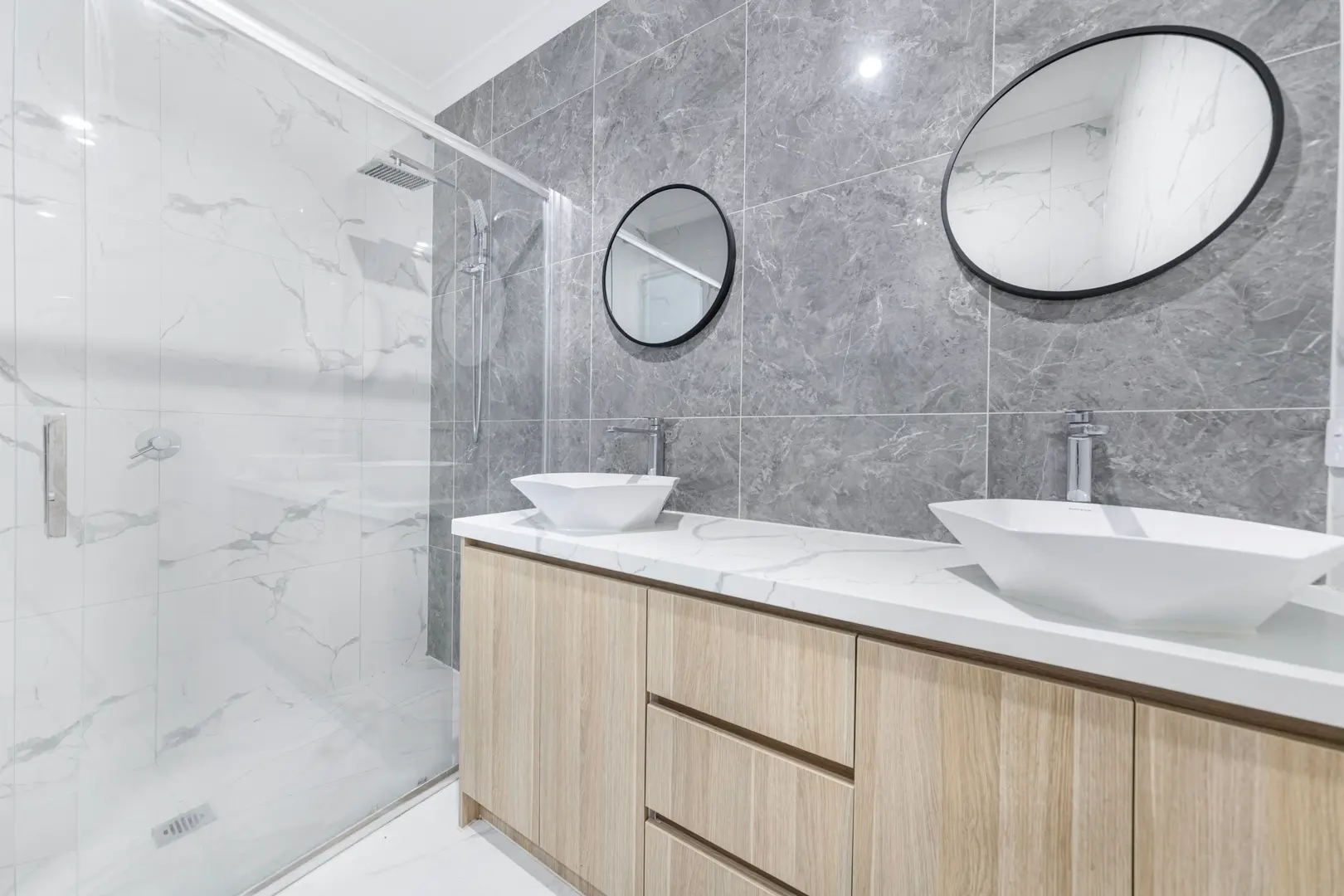
If the vanity contains two basins, you can use one wide mirror across the full arrangement or separate mirrors above each basin. In either case, the design should look intentional. Avoid a mirror width that seems unrelated to the basin positions or leaves one side of the vanity visually heavier than the other.
Before buying, mark the proposed mirror outline on the wall with removable tape or paper. Viewing that outline from the doorway and from the vanity can make proportion problems more obvious than measurements alone.
What Is the Right Height for a Bathroom Mirror?
A bathroom mirror should generally be centred around the average eye level of the people who use it. The most important goal is to give users a comfortable view without requiring them to bend down or stretch upward.
Rather than placing the mirror according to the ceiling alone, consider:
- The heights of regular users
- The top of the vanity and basin
- The position of taps and splashbacks
- Wall-mounted lighting
- Available space below the ceiling
- Cabinets or other nearby fixtures
In a shared or family bathroom, the mirror should cover a useful range of viewing heights. A taller mirror can make this easier because it accommodates more users without needing to be placed unusually high or low. It may also draw the eye upward and emphasize the room’s vertical lines.
Tall mirrors still need to suit the scale of the room. If a mirror nearly fills the entire wall above a small vanity, it may dominate the design. Leave enough surrounding wall visible to maintain a sense of structure, unless a wall-spanning mirror is part of a deliberate minimalist scheme.
High ceilings can make a standard mirror look undersized or visually isolated. In that situation, a taller mirror may connect the vanity with the upper part of the room. You do not necessarily need to fill all the available wall space. The mirror should remain related to the vanity rather than appearing to float between the counter and ceiling.
Unusual layouts may require further adjustment. A low window, sloped ceiling, wall light, or medicine cabinet can affect ideal placement. Prioritize a clear reflection and comfortable use, then refine the position to suit the architecture.
When Can a Bathroom Mirror Be Too Large?
A mirror may be too large when it overwhelms the vanity, leaves no visual breathing room, or makes other bathroom features appear cramped. This is most noticeable in small bathrooms, where an oversized mirror can dominate the limited wall area.
Common signs that a mirror may be disproportionate include:
- It extends awkwardly beyond the vanity.
- Its edges sit uncomfortably close to walls, cabinets, or light fixtures.
- The vanity looks too small to support it visually.
- A decorative frame crowds the surrounding area.
- The mirror becomes the only feature noticed when entering the room.
However, a large mirror is not automatically the wrong choice. Large reflective surfaces can increase the sense of brightness and openness, and they often work well in minimalist interiors. A broad frameless mirror, for example, can blend into a simple bathroom more easily than a smaller mirror with a thick, ornate frame.
Scale depends on visual weight as well as physical dimensions. Dark frames, carved details, and unusual shapes can make a mirror feel larger and heavier. Frameless designs and slim frames tend to have a lighter presence, even when the reflective area is generous.
Consider what the mirror reflects as well. A large mirror gives greater prominence to whatever is opposite it. If it reflects daylight or a clean, uncluttered wall, the effect may feel open and calm. If it reflects crowded shelving or visual clutter, the room may instead feel busier.
The best approach is to evaluate the mirror as part of the whole vanity wall. It should support the room’s proportions rather than simply occupy the maximum available area.
Is One Bathroom Mirror Better Than Two?
One mirror and two mirrors create different visual effects, and neither option is universally better.
A single mirror provides a seamless appearance. Above a double vanity, it can visually connect both basins and create one broad reflective surface. It may also be useful when people want more viewing area or when the room has a clean, uninterrupted design.
One mirror may be preferable when:
- You want a simple, unified vanity wall.
- The bathroom benefits from a broad reflection.
- Users move between different areas of the counter.
- The vanity design is already visually divided by drawers or basins.
- You prefer fewer frames and decorative lines.
Two mirrors introduce symmetry, particularly when each one is centred above a basin. They can define personal areas in a shared bathroom and create space between the mirrors for a light, decorative object, or another design feature.
Two mirrors may work well when:
- Two people regularly use the vanity together.
- Each basin needs a clearly defined mirror.
- The bathroom design emphasizes symmetry.
- Separate wall lights or storage elements divide the vanity.
- You want framed mirrors to act as individual focal points.
Think about usage habits before deciding. If one person frequently uses the centre of the vanity or wants a continuous view, one wide mirror may be more practical. If two people have separate basin areas and use them simultaneously, two mirrors can provide a clearer sense of organization.
With two mirrors, consistent alignment is important. Their shape, size, height, and relationship to the basins should feel deliberate. With one mirror, make sure its width relates to the full vanity rather than only one basin.
Which Mirror Shape Suits a Bathroom Best?
Mirror shape affects both function and mood. The best option depends on the available wall area, the amount of reflection needed, and the lines already present in the bathroom.
Rectangular mirrors provide a generous viewing area and usually fit naturally above a vanity. Their straight edges coordinate easily with counters, cabinets, tiles, and doors. A horizontal rectangle can emphasize width, while a vertical rectangle can draw attention upward.
Round mirrors can soften a room filled with straight lines and hard surfaces. They are often useful in smaller bathrooms because their curved outline creates a focal point without filling every corner of the available wall space. A round mirror may also help a narrow vanity area feel less rigid.
The trade-off is that a round mirror can offer less usable reflective area than a rectangular mirror occupying the same overall wall zone. Make sure its centre and diameter provide a comfortable view before choosing it for appearance alone.
Oval mirrors combine soft curves with a more vertical viewing area. They can suit bathrooms that need some visual height but would benefit from a less angular design.
Irregular or asymmetrical mirrors create an artistic effect. They work especially well when the mirror is intended to be decorative as well as practical. Because an unusual outline attracts attention, it should coordinate with the rest of the room rather than compete with patterned tile, prominent lighting, or detailed cabinetry.
When comparing shapes, ask two questions: Does the mirror provide enough reflection for everyday use, and does its outline complement the dominant lines in the bathroom? A visually striking shape is most successful when it still performs its basic function comfortably.
How Can You Coordinate a Mirror With Your Bathroom Design?
The mirror should relate to the bathroom’s broader style, including the vanity, taps, hardware, lighting, tile, and colour palette. Coordination does not require every finish to match exactly, but the elements should share a consistent visual direction.
For a traditional bathroom, a framed mirror can echo the detail of the vanity or cabinetry. In a contemporary setting, a slim frame, simple shape, or frameless mirror may feel more appropriate. Organic curves and natural-looking finishes can soften a bathroom dominated by hard, geometric surfaces.
Frameless mirrors are particularly versatile. Their understated edges allow them to work with many decor styles, and they do not introduce another finish that must be coordinated with taps or cabinet hardware. They can also make a generous mirror feel visually lighter.
Frames offer more opportunity to create contrast or repetition. A frame can relate to:
- Vanity hardware
- Tap finishes
- Shower framing
- Wall lights
- Cabinet colours
- Other decorative accents
Avoid adding a strong frame simply because it matches one small feature. Consider its visual weight against the entire vanity wall. A thick frame may suit a substantial vanity but overpower a delicate basin or compact room.
Modern mirrors may also include integrated technology, such as built-in lighting or anti-fog features. These options can reduce the need for separate fixtures and support daily routines, but their appearance and placement still need to suit the bathroom. Check that integrated lighting provides the type of illumination you want and that controls are convenient to access.
Technology should complement good sizing rather than compensate for poor proportion. Start by selecting a mirror that suits the vanity and users, then compare the features available within that size and style.
What Mirror Works Best in a Small Bathroom?
In a small bathroom, a mirror should increase the sense of light and openness without making the vanity wall feel crowded. A relatively generous reflective surface can help distribute available light and create more visual depth.
Tall mirrors are particularly useful when wall width is limited. By extending the reflection upward, they can make walls appear more elongated and emphasize ceiling height. A vertical rectangular or oval design often works well above a narrow vanity.
Round mirrors are another effective choice. Their curved edges leave portions of the wall visible, which can prevent a compact area from feeling boxed in. They also introduce contrast when the bathroom contains many square tiles, cabinets, and fittings.
Frameless mirrors and slim frames usually suit compact rooms because they have less visual weight. Heavy or ornate frames may occupy valuable wall space and make the area feel busier. If you want a decorative frame, choose one that adds character without overpowering the vanity.
To improve the result:
- Position the mirror where it can reflect available natural or artificial light.
- Keep its width proportionate to the vanity.
- Use height when horizontal wall space is restricted.
- Avoid crowding the mirror with shelving or bulky lights.
- Consider what will appear in the reflection.
- Keep nearby surfaces visually organized.
A large mirror can work in a small bathroom when the rest of the design is restrained. Minimal cabinetry, simple finishes, and an uncluttered counter allow the mirror to expand the space visually rather than overwhelm it.
How Ventilation Influences Bathroom Mirror Fogging
Shower steam commonly causes bathroom mirrors to fog, temporarily reducing visibility. This can happen with many standard mirrors when warm, moist air reaches the cooler mirror surface. Mirror size does not eliminate the issue, so ventilation and anti-fog features may be worth considering during selection.
Adequate ventilation can remove moist air more effectively, which may reduce the duration or severity of fogging. It can also help limit the damp conditions associated with moisture-related mould issues elsewhere in the bathroom.
Experiences differ, however. Some people find that effective ventilation keeps their mirror noticeably clearer, while others report that mirrors still fog after a hot shower. Ventilation may reduce moisture without guaranteeing a completely clear surface in every bathroom. Shower temperature, room layout, airflow, and the mirror’s position can all influence the practical result.
Anti-fog mirror technology offers another option. Some modern mirrors include built-in demisting features. Applied anti-fog treatments, including products such as Rain-X, are also used by some homeowners. Results can vary, and these treatments may require regular reapplication. Always follow the product directions and confirm that the chosen treatment is suitable for the mirror.
For the most practical setup, combine an appropriately sized mirror with good bathroom ventilation. If fogging remains a frequent problem, consider a mirror with an integrated anti-fog feature or a suitable applied treatment rather than assuming that a different mirror size alone will solve it.