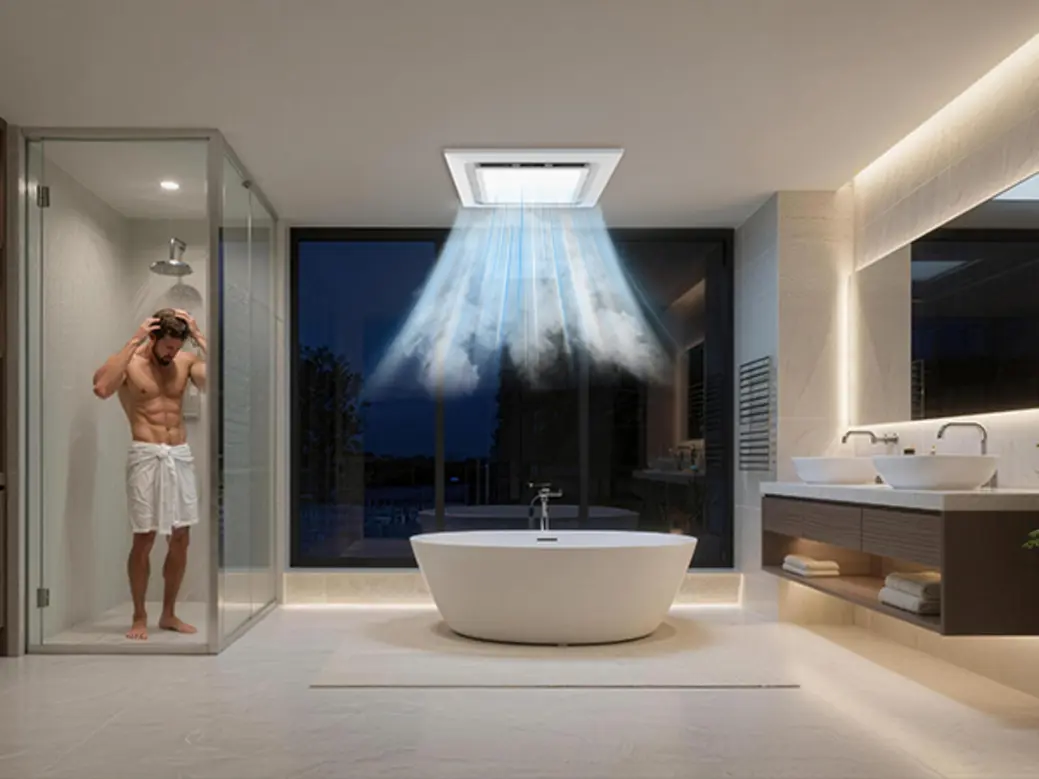
How Long Should You Run a Bathroom Exhaust Fan After a Shower?

Run the bathroom exhaust fan during the entire shower and for about 20 minutes afterward as a practical starting point. If the room is still steamy, mirror condensation remains, or surfaces feel damp after that time, leave it on longer—often closer to 30 minutes—while you check whether the fan is actually moving moist air outdoors.
The reason to keep the fan running after showering is simple: much of the moisture is still in the air and on wet surfaces after the water is turned off. Turning the fan off as soon as the shower ends can leave that moisture to settle on walls, ceilings, mirrors, towels, and the shower curtain or liner.
A practical bathroom fan run-time rule
Use this as an everyday guide:
| Bathroom situation | Suggested fan use |
|---|---|
| Quick shower in a small bathroom that dries easily | Run during the shower and about 15–20 minutes afterward |
| Typical shower in an average bathroom | Run during the shower and about 20–30 minutes afterward |
| Long or hot shower, visible steam, or a windowless bathroom | Run during the shower and at least 30 minutes afterward |
| Bathroom still damp after the usual run time | Keep the fan on until moisture clears, then investigate airflow or ventilation problems |
These are useful starting ranges, not a guarantee that every bathroom will dry in the same time. A fan with weak airflow, a long or obstructed duct, outdoor humidity, and a very steamy shower can all extend the time needed.
Turn the fan on before the shower if possible
Starting the exhaust fan just before turning on the water gives it a head start. It begins pulling room air toward the vent before steam fills the space, rather than trying to catch up after humidity has already spread through the bathroom.
Keep the bathroom door mostly closed while showering if that helps the fan contain and remove moisture from the room. Throwing the door wide open immediately can send humid air into a hallway, bedroom, or other nearby space instead of directing it toward the exhaust fan.
After the shower, open the shower curtain fully or slide the shower door open so the wet enclosure can dry. Do not leave a shower curtain bunched tightly at one end. Spread it out so air can reach both sides and moisture is less likely to linger in folds.
When to turn off the bathroom exhaust fan
Turn the fan off when the bathroom has noticeably cleared: the mirror is mostly clear, the air no longer feels heavy or steamy, and new condensation is not collecting on cool surfaces.
A bathroom will not become perfectly dry the moment the fan switches off. Wet tile, grout, bath mats, and towels naturally need time to air-dry. The goal is to remove the humid air before it keeps condensing throughout the room or drifts into the rest of the home.
If you need a simple routine, a timer switch is often easier than trying to remember. Set it for the amount of time your bathroom normally needs after showering. A humidity-sensing switch can also be useful, but it should still be checked occasionally to make sure it runs long enough and shuts off as expected.
What changes the ideal run time?
Shower length and water temperature
A longer shower puts more moisture into the room. Very warm water also tends to create more visible steam than a short, cooler shower. If the mirror is fully fogged and walls are wet with condensation, use the longer end of the suggested range.
Bathroom size and layout
A small bathroom can fill with steam quickly, but it may also clear quickly if the fan is effective. A larger bathroom has more air to exchange, while a layout with a separate toilet area, alcove shower, or poorly placed fan may leave pockets of damp air behind.
Whether the bathroom has a window
A window can provide additional ventilation when outdoor conditions are suitable, but it does not automatically replace an exhaust fan. On a humid or rainy day, opening a window may not help much with drying. In cold weather, it can also make the room uncomfortable without necessarily solving an airflow problem.
Use the fan as the primary moisture-control tool when it vents outside. Consider an open window as a supplement when it clearly helps the room air out.
Fan condition and duct path
A clean, properly connected fan can remove moisture far more effectively than one with a clogged grille, a weak motor, or restricted ducting. A fan may sound as though it is operating while moving very little air.
Dust on the grille can reduce airflow. Turn off power at the appropriate switch or circuit before cleaning the cover, and follow the manufacturer’s instructions for your specific unit. Avoid spraying liquid cleaner directly into the fan housing or electrical components.
How to tell whether the fan is clearing moisture
You do not need specialized tools to notice basic signs of performance. After a normal shower, look for these improvements while the fan runs:
- Steam gradually thins rather than staying dense in the room.
- Mirror fog begins to clear.
- Condensation stops building on the ceiling, walls, or window.
- The bathroom no longer feels unusually humid after the usual post-shower run time.
- Musty odors become less persistent once the room and textiles are dry.
A small humidity monitor can add useful context if the bathroom often feels damp. It cannot diagnose a fan by itself, but it can show whether humidity is dropping after the shower instead of remaining elevated for a long period.
If the bathroom stays damp after 30 minutes
Running the fan longer may help, but persistent condensation is often a sign that the issue is not just the timer setting. Work through the most visible causes first.
Clean the fan cover and check the room
Remove lint and dust from the grille. Also check everyday moisture traps: a bunched shower curtain, soaked bath mat left on the floor, damp towels piled together, or a closed shower enclosure can slow drying.
Hang towels open to dry, spread the curtain or liner out, and pick up or hang the bath mat when it remains wet. These small habits reduce the amount of moisture sitting in the room after the fan has done its work.
Look for signs of poor exhaust
If the fan is unusually loud, rattles, runs inconsistently, produces little apparent air movement, or leaves the room wet after every shower, it may need service. Duct problems can also matter: disconnected, crushed, leaking, overly long, or blocked ducting can prevent a fan from exhausting effectively.
An exhaust fan should send air outside, not into an attic, wall cavity, crawlspace, or another enclosed area. If you cannot verify where it vents, or suspect a ducting or electrical issue, have a qualified installer or ventilation professional assess it.
Consider whether the fan suits the room
An undersized fan may struggle in a larger, high-use, or especially humid bathroom. Replacing or altering a fan can involve electrical connections, ceiling access, ductwork, and exterior venting, so it is a job to plan carefully rather than solve by simply choosing a longer timer setting.
Check the manufacturer documentation for your fan’s intended use and maintenance instructions. If local requirements apply to bathroom ventilation work in your area, verify them with the relevant local authority or a qualified professional.
A few habits that help reduce bathroom humidity after a shower
The fan does the main work, but these habits make drying easier:
- Start the fan before or at the beginning of the shower.
- Keep it running for roughly 20 minutes afterward, extending to 30 minutes or more when the room remains steamy.
- Open the curtain or shower door after bathing so the enclosure can dry.
- Hang towels and bath mats so air reaches them.
- Wipe down heavy water on glass doors or tile if condensation is consistently severe.
- Clean the fan grille periodically and pay attention to changes in sound or performance.
For cleaning fumes, do not assume a bathroom fan alone makes any product safe to use in an enclosed room. Follow the cleaner’s label directions for ventilation, protective measures, and mixing warnings. Never mix cleaning products unless the manufacturer specifically says it is safe.
The simple answer
For most bathrooms, run the exhaust fan throughout the shower and for about 20 minutes afterward. Move up to 30 minutes or longer for a long, steamy shower, a windowless room, or a bathroom that dries slowly. If the space is still damp every day despite adequate run time, focus on fan cleanliness, airflow, ducting, and whether the fan is venting outdoors rather than leaving it on indefinitely.
References
- How to prevent mold in bathroom with current fan and air …. (n.d.). https://www.facebook.com/groups/askriverivew/posts/874480633338873
- How Long To Run Your Bathroom Exhaust Fan To Prevent Mold And Mildew. (n.d.). https://shopping.yahoo.com/home-garden/cleaning/articles/long-run-bathroom-exhaust-fan-224500226.html
- How Long To Run Your Bathroom Exhaust Fan To Prevent Mold And Mildew - AOL. (n.d.). https://www.aol.com/articles/long-run-bathroom-exhaust-fan-224500637.html
- Bathroom Fan Run‑Time: How Long Is “Enough”? - Breathe Atlas. (n.d.). https://breatheatlas.com/ventilation-co2/bathroom-fan-runtime
- How Long Can a Bathroom Exhaust Fan Run -. (n.d.). https://aosvents.com/es/cuanto-tiempo-puede-funcionar-un-extractor-de-aire-de-bano
- How Long To Run Your Bathroom Exhaust Fan To Prevent Mold And Mildew - AOL. (n.d.). https://www.aol.com/articles/long-run-bathroom-exhaust-fan-224500000.html
- When bath fan doesn’t help humidity. (n.d.). https://www.hvac-talk.com/threads/when-bath-fan-doesnt-help-humidity.175266
- Healthy Home: Controlling Moisture. (n.d.). https://www.broan-nutone.com/en-us/home/learn/controlling-moisture