How to Remove Limescale from Your Bathroom
Limescale can make an otherwise clean bathroom look dull and neglected. It forms around taps, inside toilets, on shower screens, and in shower-head nozzles—particularly in hard-water areas. Left untreated, it may also restrict water flow and interfere with plumbing fixtures or appliances.
Fortunately, learning how to remove limescale does not require a complicated cleaning routine. Commercial descalers can work well, while household ingredients such as vinegar and lemon juice offer practical alternatives for many bathroom surfaces.
Understanding Limescale and Its Causes
Limescale is a hard, chalky deposit made primarily from calcium carbonate. It appears when hard water evaporates and leaves its dissolved minerals behind.
You will commonly find it:
- Around the base and spout of taps
- Inside shower-head nozzles
- Beneath the rim or waterline of a toilet
- On shower screens and tiles
- Inside kettles and water-using appliances
- Within pipes and plumbing fixtures
Soap can contribute to the problem. When soap residue combines with hard-water minerals, it creates stubborn deposits on baths, basins, tiles, and shower enclosures. These marks may look cloudy, white, grey, or slightly brown depending on the surface and surrounding residue.
Fresh deposits are generally easier to remove than thick, hardened layers. That is why frequent light cleaning is usually more effective than waiting until significant buildup has developed.
Can Limescale Damage Your Plumbing and Appliances?
Limescale is not only a cosmetic concern. Deposits can gradually collect inside pipes, taps, valves, and water-using appliances. As the available space narrows, water flow may become restricted.
Possible consequences include:
- Reduced pressure or flow from taps and shower heads
- Partial pipe blockages
- Poor appliance performance
- Higher energy or utility costs
- Shorter appliance service life
- Problems with components such as flow sensors
A sensor that cannot accurately detect water flow may cause an appliance to function incorrectly. Similarly, a heating element coated in scale may operate less efficiently because the buildup interferes with normal performance.
The visible scale around a tap does not necessarily reveal how much is present inside the plumbing. If water flow remains weak after the accessible parts have been cleaned, there may be an underlying issue that requires professional attention.
Effective Ways to Clean Away Limescale
There are two main approaches: a commercial limescale remover or an acidic homemade solution.
Commercial products are formulated for descaling and can be convenient for heavy deposits. Always check that a product is suitable for the material you intend to clean. Follow its directions for application time, ventilation, rinsing, and protective equipment.
Vinegar and lemon juice are popular natural alternatives. Their acidity helps loosen calcium carbonate so that the deposit can be wiped or scrubbed away. They may also reduce the environmental impact associated with using stronger specialist cleaners, depending on the product and how it is used.
The right choice depends on:
- The thickness of the deposit
- The surface or finish
- Whether the item can be soaked
- The amount of time available
- The product’s safety instructions
A mild remover may need several applications. This does not always mean it is ineffective; a thick mineral layer can take time to dissolve. Avoid compensating with aggressive scraping, which may damage the surface beneath the scale.
Homemade Limescale Removal Methods
Several inexpensive household ingredients can help with bathroom limescale:
White vinegar: Soak a cloth in vinegar and place it directly over the affected area. Leave it in contact with the scale before wiping and rinsing. Removable fixtures can often be soaked for longer, including overnight when the finish is compatible.
Lemon juice: Apply lemon juice to the deposit with a cloth or use it as a soaking solution. It is particularly useful around taps and shower heads, and it may work faster than vinegar in some situations.
Baking soda: Baking soda can be used as a gentle cleaning paste when mixed with a small amount of water. Its mild abrasive action can help lift loosened residue, but it should still be tested on a discreet area before use.
Hot water: After an acidic treatment has loosened the scale, hot water helps rinse away residue. It is not usually enough to dissolve established limescale on its own.
For removable items, follow this straightforward process:
- Remove loose dirt and soap residue.
- Place the affected section in vinegar or lemon juice.
- Leave it to soak, potentially overnight for substantial deposits.
- Wipe or gently scrub away the softened scale.
- Rinse thoroughly and dry.
- Repeat if a mineral layer remains.
Overnight soaking often works well for faucets and shower heads, although some scrubbing may still be necessary. Persistent buildup may take more than one treatment.
Vinegar can also be used to descale a compatible kettle by heating a diluted vinegar-and-water solution inside it. More than one cycle may be needed for heavy deposits. Always follow the kettle manufacturer’s care instructions, rinse it thoroughly, and never immerse its electrical parts.
Unconventional Methods for Removing Limescale
Coca-Cola is sometimes suggested as an unconventional limescale treatment because it is acidic. It may loosen some deposits when left in contact with them, especially in a toilet bowl.
However, its performance is less established than that of vinegar, lemon juice, or a dedicated descaler. It can also leave a sticky or coloured residue that requires additional cleaning.
If you are considering this method, weigh convenience against predictability:
| Method | Potential advantage | Limitation |
|---|---|---|
| Coca-Cola | Readily available and acidic | May leave residue and is less predictable |
| Vinegar or lemon | Inexpensive and straightforward | May require soaking and repeated use |
| Specialist descaler | Designed specifically for mineral buildup | Requires careful surface and safety checks |
For valuable, delicate, or plated fixtures, an approved specialist product may offer clearer instructions and better material guidance. Whichever option you choose, test it on an inconspicuous spot first.
Supplies and Safety Gear for Limescale Removal
Gathering everything before you begin makes the process easier. Useful supplies include:
- Protective cleaning gloves
- White vinegar
- Lemon juice
- Baking soda
- Soft cloths
- A non-scratch sponge or suitable brush
- A bowl or container for soaking
- Elastic bands for securing soaked cloths
- Hot water
- A surface-appropriate commercial descaler, if needed
Although vinegar and lemon juice are household ingredients, they are acidic cleaners and should be handled carefully. Wear gloves, ventilate the bathroom, and avoid contact with your eyes or irritated skin.
Never combine an acidic cleaner with bleach or bleach-based toilet products. Rinse away one cleaner completely before applying another. Read all commercial-product labels, and do not leave an acidic solution on a surface longer than its manufacturer recommends.
Natural does not automatically mean safe for every material. Acid can affect certain stone surfaces, grout, plated finishes, and other sensitive materials. Check the care guidance for your fixture and test a hidden area before treating a visible section.
Removing Limescale from Household Pipes
Before treating a slow pipe or drain, first clear away accessible hair, soap, and debris. Limescale treatment will not solve a blockage caused by a physical obstruction.
For a basic household method:
- Remove visible debris and clear the pipe opening.
- Add baking soda.
- Pour in vinegar gradually.
- Allow the reaction to settle and give the solution time to work.
- Finish by flushing the pipe with boiling water, where appropriate for the plumbing system.
The bubbling reaction may help disturb residue, while the vinegar can work on mineral deposits. Nevertheless, this approach is best suited to accessible, minor buildup. It cannot confirm or remove a serious obstruction deeper in the plumbing.
Avoid relying repeatedly on harsh chemical drain cleaners. They may not address the underlying cause of reduced flow and can potentially cause further damage if used incorrectly. Persistent blockages, recurring slow drainage, or continuing flow problems should be assessed by a qualified plumber.
A Simple Method for Descaling Taps
Taps are among the most visible places for mineral deposits, but soaking can loosen them without forceful scraping.
- Soak a soft cloth in vinegar or lemon juice.
- Wrap the cloth around the scaled section of the tap.
- Secure it with elastic bands so it remains in contact with the deposit.
- Leave it for several hours or overnight if the finish permits.
- Remove the cloth and gently scrub any remaining scale.
- Rinse the tap thoroughly and dry it.
For scale around the end of the spout, a small container or bag of cleaning solution can be secured so that the affected section is submerged.
Do not use vinegar on plated taps unless the manufacturer confirms that it is safe. Prolonged acidic contact may harm some decorative finishes. Lemon juice may be an alternative for certain fixtures, but compatibility should still be checked. For delicate taps, use a cleaner specifically approved for that finish.
How to Clear Limescale from a Toilet
Vinegar provides a simple non-chemical-style alternative to stronger toilet descalers, although it is still an acidic cleaner.
Pour or apply vinegar directly to the visible deposits and allow it to remain in contact with them. Scale beneath the toilet rim can be difficult to reach, so use a suitable bottle or applicator to direct the cleaner upward. A toilet cleaner designed for under-rim application can also provide better coverage.
After soaking:
- Scrub with a toilet brush.
- Flush to rinse.
- Inspect the waterline and under-rim area.
- Repeat the treatment if deposits remain.
Very persistent marks may be treated with fine wet sandpaper, but this should be a last resort. Keep it wet, use minimal pressure, and restrict it to compatible toilet-bowl surfaces. Careless sanding can leave scratches that make future staining and buildup more noticeable. Never use this method on plastic seats, plated parts, or decorative finishes.
Before using vinegar, make sure there is no bleach-based cleaner left in the bowl or cistern. Never mix the two.
Descaling a Shower Head at Home
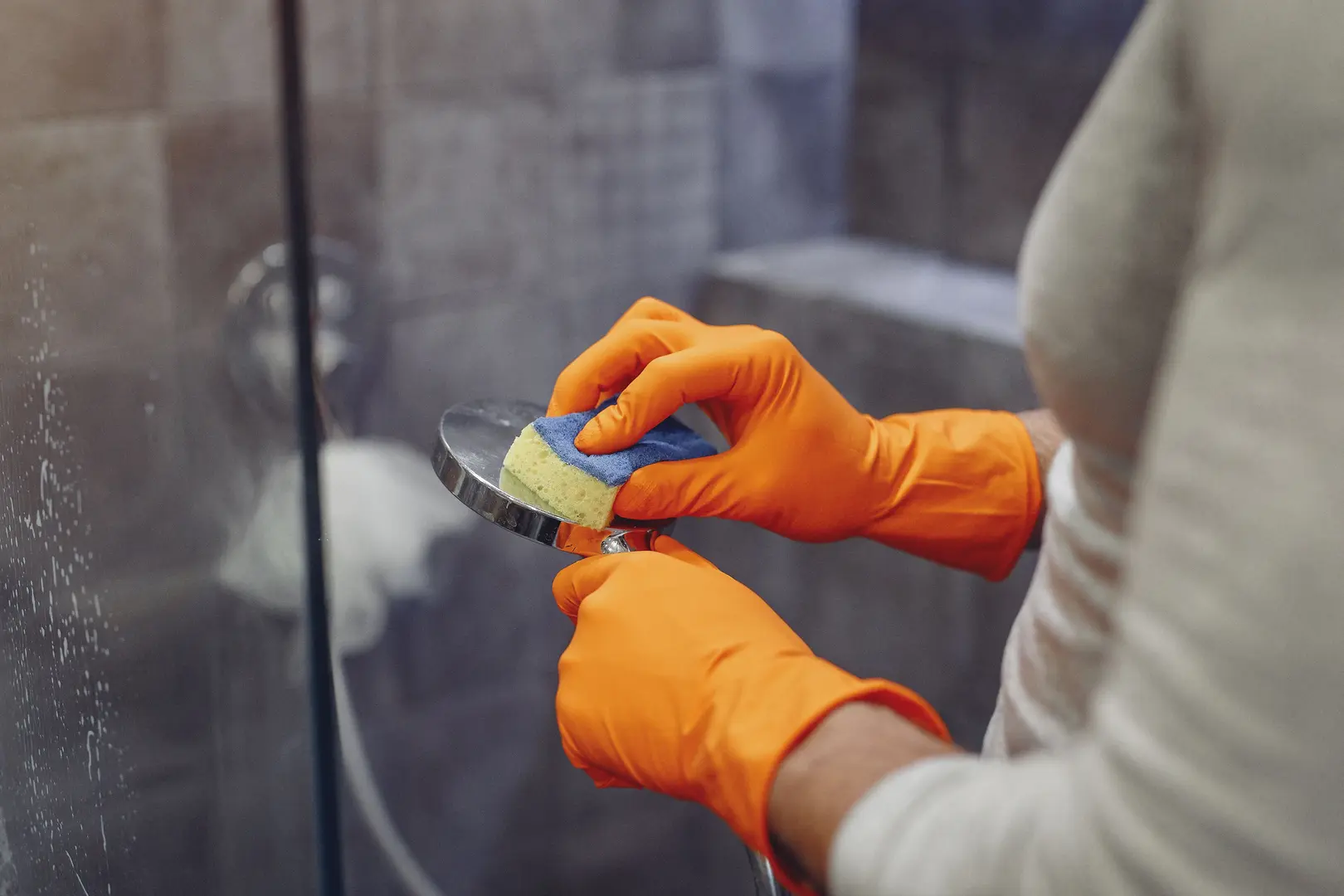
A scaled shower head may spray unevenly or deliver less water because deposits are blocking its nozzles. If the head is removable, unscrew it and submerge the affected section in a bowl of vinegar or lemon juice.
Leave it to soak long enough for the mineral deposits to soften. Overnight treatment can help with heavier buildup, although the material and manufacturer’s instructions should determine the maximum soaking time.
Lemon juice may act faster than vinegar and can be preferable for chrome surfaces. Even so, check the fixture’s care instructions before prolonged soaking.
Once soaked:
- Remove the shower head from the solution.
- Gently brush the face and nozzles.
- Rinse it thoroughly with clean water.
- Refit it and run the shower to flush the openings.
If the shower head cannot be removed, wrap it in a soaked cloth or secure a bag of solution around it. Repeat the process rather than using sharp tools that could damage the nozzles or finish.
Ways to Stop Limescale Building Up Again
Prevention reduces the need for intensive descaling. The most effective habits are simple:
- Wipe taps, shower screens, tiles, and fixtures dry after use.
- Clean small deposits regularly before they harden.
- Remove soap residue from wet surfaces.
- Check shower-head nozzles and tap outlets periodically.
- Descale compatible appliances according to their care instructions.
- Consider a water softener if hard water causes widespread, recurring buildup.
Keeping a cloth or squeegee close to the shower makes daily drying more convenient. Pay particular attention to joints, tap bases, screen edges, and other areas where water tends to collect.
Regular maintenance will not change the mineral content of hard water, but it limits the time available for water to evaporate and leave deposits behind. Combined with occasional vinegar, lemon, or surface-appropriate descaling treatments, this can keep bathroom fixtures cleaner and help water flow as intended.