How to Stop a Shower Curtain From Leaking Water Onto the Floor

A shower curtain leaking water onto the floor is usually caused by water escaping at one of four places: the liner is outside the tub, the side edges do not stay against the walls, the curtain is too short or narrow, or the shower spray is hitting the opening too forcefully. Start by finding the wettest spot after a shower. That tells you which part of the setup needs attention.
For most tub-and-curtain setups, the waterproof liner belongs inside the tub while the decorative fabric curtain stays outside. The liner should hang low enough to direct water into the tub, overlap the side walls, and remain close to the tub rather than billowing toward the room.
Find Where the Water Is Escaping
Before buying weights or replacing the curtain, inspect the pattern of water on the floor. Dry the floor, take a short shower, then check where moisture first appears.
| Where the floor gets wet | Likely cause | First fix to try |
|---|---|---|
| Along the front of the tub | Liner is outside the tub or is too short | Move liner inside; check length |
| At one or both wall ends | Side gaps or liner pulls away | Improve overlap; add side holders or guards |
| Near the curtain opening | Panels do not overlap enough | Increase overlap or change closing arrangement |
| Across a wider area | Spray is aimed outward or bouncing off a wall | Adjust showerhead direction and water flow |
| Near the base of the wall | Water may not be coming from the curtain | Check for a tub, wall, door, or plumbing leak |
If water appears even when nobody is showering, or if it seems to come from behind the tub, wall, faucet, or drain area, do not assume the curtain is the cause. A persistent leak around bathroom fixtures or behind finished surfaces needs prompt attention from the property owner, building maintenance team, or an appropriate repair professional.
Put the Liner Inside the Tub
The liner is the water barrier. Its bottom edge should sit on the inside of the tub basin, not drape over the outside rim. When it is placed outside, water can run down the liner and directly onto the bathroom floor.
The decorative curtain may hang outside the tub for appearance and to help protect it from direct spray. If your setup uses one curtain only, that curtain still needs to stay inside the tub while showering unless its care and use instructions clearly indicate otherwise.
Also check the liner after it has been pulled closed. It can look correct at first but get caught over the tub edge near one end. Run your hand along the bottom edge before turning on the water to make sure it is fully inside.
Stop the Liner From Blowing Inward
A lightweight liner can move toward the shower stream, especially with strong water pressure, an exhaust fan running nearby, or a narrow tub. Once the liner blows inward, a gap can open at the tub edge or side wall.
Try these practical options:
- Use a liner with weighted magnets or sewn-in weights at the bottom.
- If your tub is steel or cast iron, magnetic weights may help hold the liner near the tub wall. They will not grip a fiberglass, acrylic, or other nonmetal tub.
- Use compatible suction cups or wall-mounted curtain holders at the sides if the wall surface and product instructions allow them.
- Close the liner fully before starting the shower, then smooth its bottom edge into the tub.
- Aim the showerhead away from the curtain whenever possible.
Shower curtain weights help control movement, but they cannot compensate for a liner that is too short, too narrow, or placed on the wrong side of the tub rim.
Check Curtain Width and Side Overlap
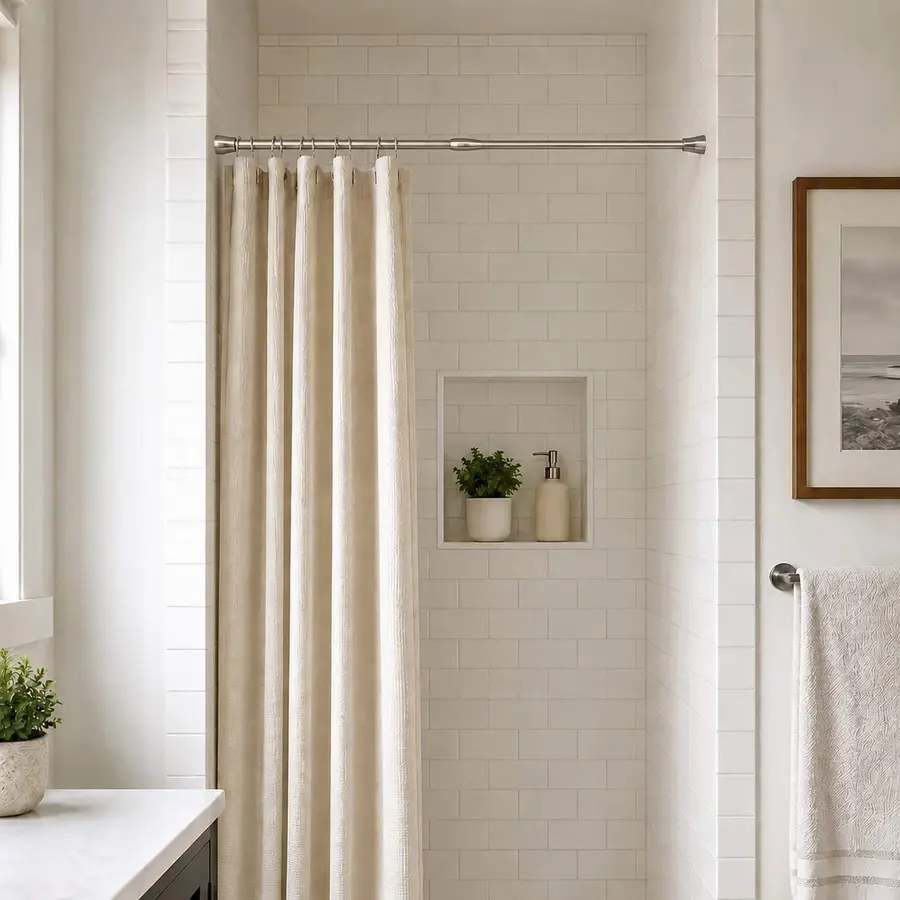
A shower curtain can be wide enough to cover the rod but still not contain water well. The key issue is whether the liner reaches beyond the wet area at both ends and has enough slack to curve inward slightly at the walls.
Pull the liner closed and look at each side where the rod meets the wall. A tight, flat liner can leave a small opening at the ends. Water can travel along the wall, enter that gap, and drip outside the tub.
For a better seal:
- Make sure the liner extends past the tub opening at both ends rather than ending exactly at the corners.
- Check that the hooks are spread evenly. Large gaps between rings can create openings along the top and sides.
- Confirm that the liner is not caught behind the decorative curtain or wrapped around a hook.
- If two curtain panels meet in the middle, arrange them so they overlap toward the inside of the tub.
- Consider a wider liner if the current one barely spans the rod or leaves exposed side gaps.
A curved rod can make a shower feel roomier, but it also changes how the liner falls. If the liner is pulled too far toward the room at the center, it may no longer wrap adequately at the ends. Reposition the liner and check the side overlap after adjusting any curved rod.
Make Sure the Liner Is Long Enough
A liner that ends well above the tub floor gives splashing water an easy route out. It should hang inside the tub with enough length to direct water downward, without being so long that it bunches heavily underfoot.
To assess length, close the liner and let it hang naturally. Check whether its lower edge reaches into the tub basin all the way across. If it rides above the tub floor, lifts when wet, or is shortened by high-mounted rings, choose a longer liner or revise the rod and hook arrangement.
Do not solve a short liner by leaving the bottom hanging outside the tub. That changes the liner from a water channel into a path for water to reach the floor.
Reposition the Rod and Hooks
Rod placement affects both coverage and curtain movement. A rod that is too far forward can pull the liner away from the tub walls or place the curtain opening where spray can reach it. A rod that sags can also lower the curtain in the middle and make the ends pull tight.
Check for these setup problems:
- The tension rod shifts when the curtain is opened or closed.
- The rod is noticeably bowed or lower at one end.
- Hooks drag, stick, or bunch together, preventing the liner from closing fully.
- The liner is hung on an outer row of a double-hook system when it should be on the inner row.
- The rod sits far enough outside the tub that the liner cannot stay inside without strain.
Secure or replace an unstable rod according to its manufacturer instructions. In a rental, avoid drilling or altering wall surfaces without permission. A properly fitted tension rod, better rings, or a liner on the correct hook row may solve the issue without permanent changes.
Reduce Splashing From the Showerhead
Sometimes the curtain is set up correctly, but the water stream is simply directed toward the opening. This is especially common when the showerhead points outward, the spray setting is very wide, or water ricochets off a tiled wall.
To stop shower curtain splashing:
- Angle the showerhead toward the center of the tub or toward the wall opposite the curtain opening.
- Avoid aiming the spray directly at the liner or side gap.
- Use a less forceful spray pattern if your showerhead offers one.
- Keep bottles, caddies, and other items from deflecting water toward the curtain.
- Test the spray direction with the curtain closed before stepping in.
If a handheld showerhead is used, keep it pointed into the tub before turning it on and while changing settings. A sudden outward spray can wet the floor even with a well-positioned liner.
Add a Splash Guard for Stubborn Corner Leaks
If water repeatedly escapes where the tub meets the wall, a shower curtain splash guard can help. These small barriers are designed to reduce the open path at the corners and guide splashed water back toward the tub.

Source: m.media-amazon
Splash guards are most useful when the basic setup is already correct but a rounded tub edge, active household showering, or forceful spray still sends water around the liner. Check that any guard is compatible with your tub shape, wall surface, and curtain arrangement. Follow the installation directions, particularly in rentals or on delicate tile finishes.
When a Curtain May Not Be Enough
A shower curtain has limits. It works best when it can hang inside a tub or shower curb with side walls that help contain water. It may struggle in an unusually open shower area, a very shallow or rounded tub, or a layout where the showerhead sends water directly toward an exposed edge.
If you have corrected liner placement, size, overlap, rod position, and spray direction but still get regular floor flooding, the bathroom may need a different containment approach. Depending on the layout, that could mean a better-fitting curtain system, a fixed splash panel, or a shower screen designed for the space. This is a layout issue rather than a failure to choose enough shower curtain weights.
Quick Checklist Before Every Shower
- Liner is inside the tub or shower curb.
- Both side edges reach the wall area without obvious gaps.
- The curtain panels overlap at the opening.
- The bottom of the liner hangs into the tub basin.
- Weights, magnets, or side holders are in place if needed.
- The showerhead points into the tub, not toward the curtain opening.
- The bath mat is outside the tub and kept dry until after the shower.
Wipe up any escaped water promptly to reduce slip risk and prevent repeated moisture exposure around flooring and baseboards. If the floor remains wet despite a correctly arranged curtain, investigate beyond the curtain itself rather than continuing to adjust the liner.
References
- How to Prevent Water From Leaking Outside a Shower Curtain - HomelyVille. (n.d.). https://homelyville.com/prevent-water-from-leaking-outside-a-shower-curtain
- How To Prevent Water From Leaking Outside a Shower Curtain | Upgradedhome.com. (n.d.). https://upgradedhome.com/how-to-prevent-water-from-leaking-outside-a-shower-curtain
- How To Keep Water From Leaking Outside A Shower Curtain | Storables. (n.d.). https://storables.com/furniture-and-design/bathroom-accessories/how-to-keep-water-from-leaking-outside-a-shower-curtain
- Shower Curtain Liner Placement 101: The Ins and Outs (Literally!) - HomeFixMagic. (n.d.). https://homefixmagic.com/does-the-shower-curtain-liner-go-inside-the-tub
- Shower Curtain Sizes: The Complete Guide for Clawfoot and Corner Tubs – Sand Snow Linen. (n.d.). https://www.sandsnowlinen.com/blogs/blog/shower-curtain-sizes-the-complete-guide-for-clawfoot-and-corner-tubs
- How to Prevent Water From Leaking Outside a Shower Curtain: 6 Tips & Tricks | Home Grail. (n.d.). https://homegrail.com/how-to-prevent-water-leaking-outside-shower-curtain
- Shower Curtains Guide: Types, Sizes, Materials & Care. (n.d.). https://www.winsham.com/blogs/view/shower-curtains-guide
- American Express. (n.d.). https://joeyzshopping.com/blogs/product-care-and-installation-guides/understanding-standard-shower-curtain-dimensions-for-your-bathroom