WC Suite Explained: What Does It Include?
The term WC suite often appears in bathroom descriptions, product listings and renovation plans. But what is a WC suite, and how is it different from an individual toilet? In simple terms, it is a complete toilet system made up of a pan, cistern and the components needed for flushing. Understanding these parts makes it easier to compare styles and choose a suitable arrangement for your bathroom.
Why Does WC Mean Toilet?
WC stands for “water closet.” Today, the initials are commonly used as another name for a toilet or the room containing one. You may see WC on bathroom plans, directional signs, product descriptions and specifications.
The name comes from the way early toilets were installed. A toilet could be placed in a small, closet-like room with a water supply, distinguishing it from other types of sanitation arrangements. That compact room became known as a water closet, which was eventually shortened to WC.
The word “closet” can be confusing because it now tends to mean a cupboard or storage area. In this older use, however, it referred to a small enclosed room. The addition of “water” identified the room as one containing a water-based toilet.
Modern use of WC can vary slightly depending on context:
- On a floor plan, WC may label a separate toilet room.
- In a bathroom description, it may refer to the toilet itself.
- In a product listing, WC can describe the pan, cistern or complete toilet suite.
- On signage, it usually indicates toilet facilities.
This means that WC is not necessarily a description of one particular toilet style. A contemporary wall-hung model, a compact toilet and a traditional exposed-cistern design can all be described using the term.
It is also useful to distinguish between a WC room and a WC suite. A WC room is the space in which the toilet is located. A WC suite is the set of components that forms the toilet system. The surrounding room may contain other fixtures, but those fixtures are not automatically part of the WC suite.
When bathroom retailers use WC in a product category, they are normally referring to equipment associated with the toilet rather than to a cupboard or general storage. Checking whether a listing covers one component or a complete suite is therefore important.
What Does a Complete WC Suite Include?
A complete WC suite is a coordinated toilet system. Its principal parts are:
- The toilet pan
- The cistern
- The flushing components
The word suite indicates that these elements form a complete matching set. Rather than selecting the pan and cistern as unrelated pieces, the buyer receives components intended to work together as one toilet arrangement.
The pan is the visible bowl section. The cistern stores the water used for flushing, while the flush components control the release of that water. Together, they perform the basic functions expected from a WC.
| Component | Main purpose |
|---|---|
| WC pan | Holds water and forms the bowl section of the toilet |
| Cistern | Stores water for the flush |
| Flushing components | Release and control the flushing water |
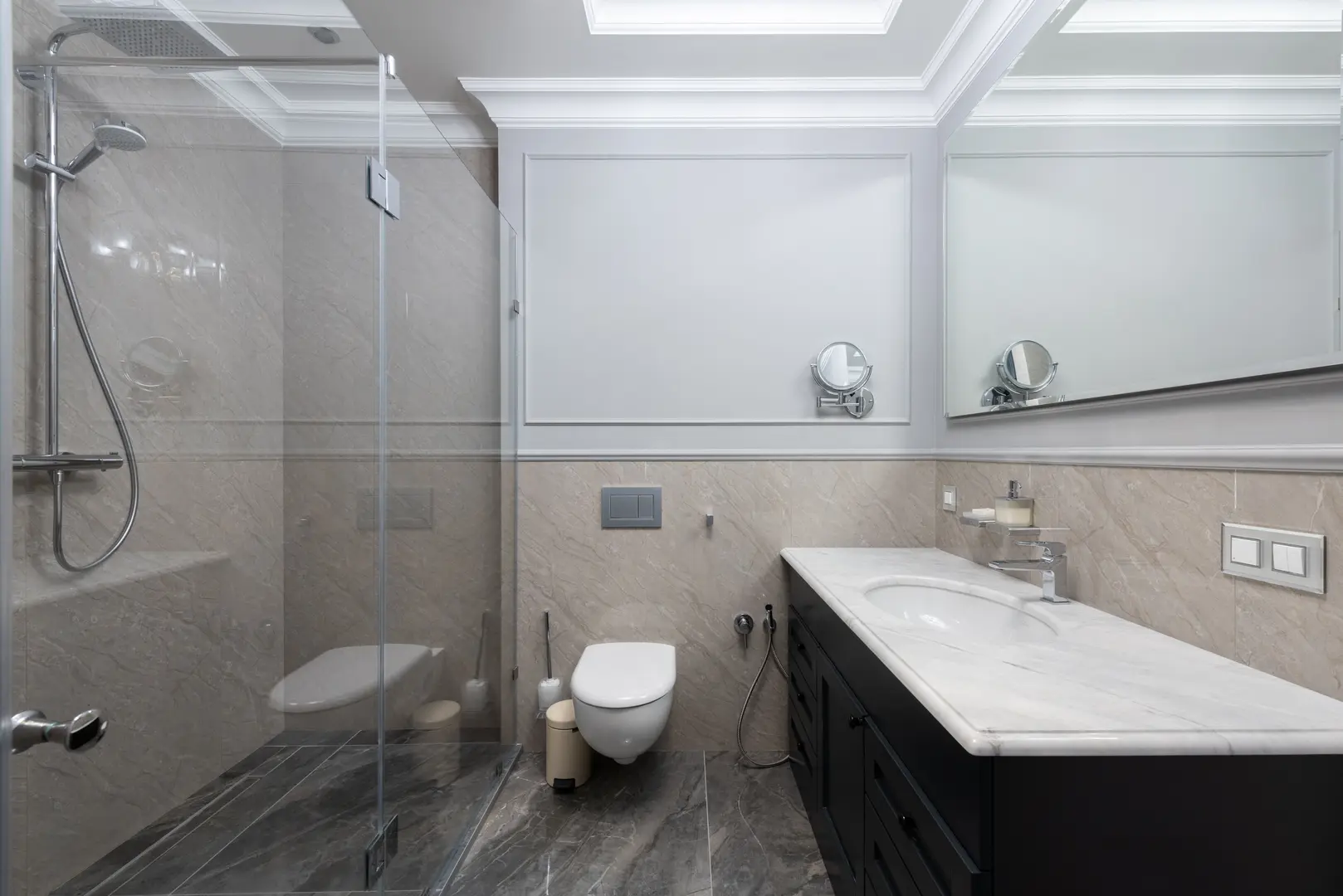
The precise appearance of a suite depends on its design. In some arrangements, both the pan and cistern remain visible. In others, the cistern is concealed, leaving the pan and flush control as the most noticeable elements. Although the presentation changes, the system still requires a pan, a water-storing cistern and a way to operate the flush.
Describing a product as a WC suite also helps distinguish it from a pan-only or cistern-only listing. A photograph may show a complete toilet, but the product description determines which parts are included. Look for clear references to the pan, cistern and flush before assuming that every visible element comes as part of the set.
A WC suite should not be confused with a complete bathroom suite. The latter term can describe a broader matching collection of bathroom fixtures. A WC suite is specifically concerned with the toilet system.
When comparing options, consider how the three core elements are presented:
- Pan design: This determines the shape and projection of the bowl.
- Cistern position: It may be visible or hidden from view.
- Flush arrangement: The suite needs components that activate and control the flush.
Choosing a complete suite can make the relationship between the main parts clearer. It indicates that the supplied elements have been grouped as one set rather than assembled from separate, unrelated designs.
However, the word “complete” should always be interpreted according to the individual product description. A WC suite means a complete toilet system in general terms, but listings may differ in how they present included items. Reviewing the component list is the best way to understand exactly what is supplied.
For planning purposes, it can help to ask three simple questions:
- Is the WC pan included?
- Is the cistern included, and is it exposed or concealed?
- Are the necessary flushing components included?
These questions focus on the defining elements of the suite and prevent confusion between a complete system and an individual replacement component.
What Is a Toilet Pan in a WC?
The WC pan, also called a toilet pan, is the bowl section of the toilet. It holds water and is the part on which the user sits. It is one of the essential components of every WC suite, regardless of whether the cistern is visible or concealed.
Toilet pans are available in a range of shapes and sizes. The best choice will depend on the available room, the intended appearance and the cistern arrangement. Some designs have rounded profiles, while others use more angular or streamlined forms. These differences allow the toilet to coordinate with either softer or more geometric bathroom styling.
Size is especially relevant in smaller bathrooms and separate WC rooms. A pan extends out into the room, so its projection influences how much space the toilet occupies visually and physically. Where space is restricted, a short-projection pan can be considered.
A short-projection design does not extend as far into the room as a more prominent pan. This makes it particularly useful where the WC must fit into a compact layout. It may help maintain a less crowded arrangement when the toilet sits near a door, wall or another bathroom fixture.
When comparing pan designs, consider:
- The overall shape of the bowl
- How far the pan projects into the room
- Whether its style matches the cistern or concealed arrangement
- How its proportions suit the available space
The pan and cistern must also be understood as parts of the same system. A pan may be visually separate from a concealed cistern, but it still relies on that cistern for flushing. In an exposed suite, the visual connection between the two parts is more obvious.
The term “toilet pan” can sometimes be mistaken for the whole toilet. In everyday speech, people often use “toilet” for the complete fixture. In product descriptions, however, a pan may be listed as an individual component. This is another reason to check whether a product is described as a pan or as a full WC suite.
Shape does not change the pan’s central purpose: it is the water-holding bowl within the WC. The available variation is mainly relevant to room planning and appearance. A compact room may benefit from a shorter design, while a larger bathroom may offer more freedom to choose a pan based on style.
Before selecting a pan, examine the bathroom as a whole rather than viewing the toilet in isolation. The pan should not appear oversized for the room, and its projection should be appropriate for the layout. If the room has limited depth, short-projection options provide a practical category to explore.
It is equally important to decide whether the pan will be paired with an exposed or concealed cistern. That decision changes the overall appearance of the completed WC suite, even when the pan itself has a similar shape.
What Is the Cistern in a WC?
The cistern is the part of the WC that stores water for flushing. When the flush is operated, the flushing components release water from the cistern into the pan. It is therefore a core part of the system rather than an optional decorative addition.
A cistern can be either exposed or concealed.
An exposed cistern remains visible as part of the toilet. The pan and cistern can be seen as a coordinated set, making the structure of the WC easy to recognise. This arrangement is often associated with traditional bathroom styles, especially where the toilet is intended to be a visible feature of the room.
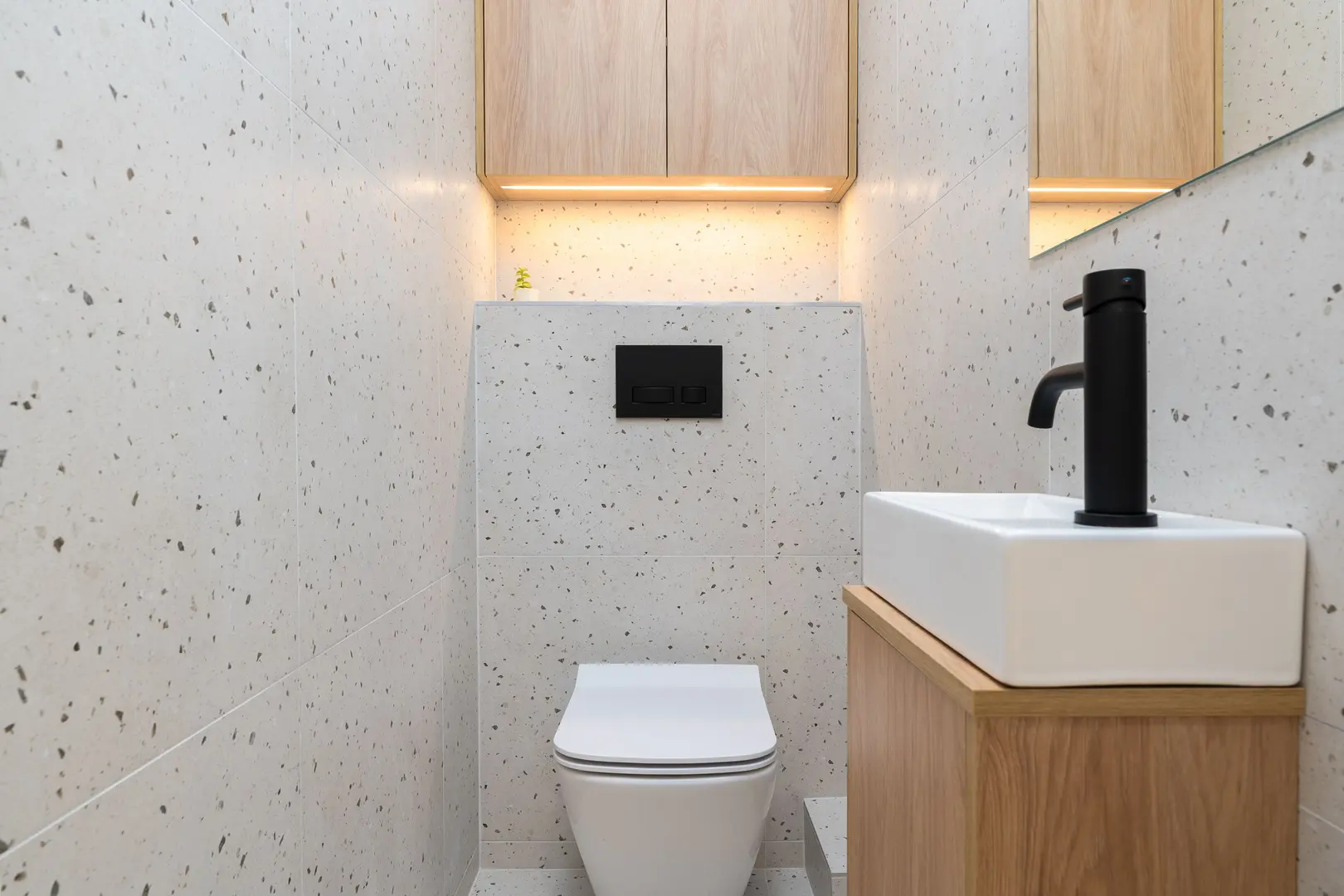
A concealed cistern is hidden from normal view. The pan and flush control remain visible, but the water-storing section sits out of sight. This creates a more streamlined appearance and can be particularly suitable for a small bathroom where reducing visible bulk is desirable.
The distinction can be summarised as follows:
| Cistern type | Appearance | Common design suitability |
|---|---|---|
| Exposed | The cistern is visible with the pan | Often suits traditional styling |
| Concealed | The cistern is hidden from view | Well suited to compact or streamlined bathrooms |
A concealed cistern still performs exactly the same central role: it stores the water needed for flushing. “Concealed” refers to how the cistern is incorporated into the bathroom design, not to a toilet that works without one.
This point can be useful when looking at modern WC images. Some designs appear to consist only of a pan and a flush control. The cistern has not been removed from the system; it has simply been placed out of sight.
For a small bathroom, concealing the cistern can make the visible arrangement feel simpler. A short-projection pan can also be considered where the room has limited depth. These are separate decisions: one concerns the visibility of the cistern, while the other concerns how far the pan extends into the room.
For a traditional bathroom, an exposed cistern can contribute to the intended character because the full toilet arrangement remains visible. The pan and cistern can be chosen as a matching set, which is central to the meaning of a WC suite.
When deciding between the two, focus on the appearance and proportions you want:
- Choose an exposed cistern if you want the cistern to form a visible part of the toilet design.
- Consider a concealed cistern if you prefer a cleaner look with fewer visible components.
- In a compact room, assess the cistern arrangement together with the pan’s projection.
- For traditional styling, compare exposed designs that present the pan and cistern as a coordinated pair.
Ultimately, the answer to “what is a WC suite?” is straightforward: it is the complete set of components that forms a working toilet, principally the pan, cistern and flushing mechanism. The key choices relate to the shape and size of the pan, whether the cistern is exposed or concealed, and how the complete set fits the style and available space of the bathroom.